- +1 (306)-721-1028
- nusrathfatimaara@gmail.com
- 3806 Albert Street Golden Mile Professional Offices
- 1(306) 540 2121

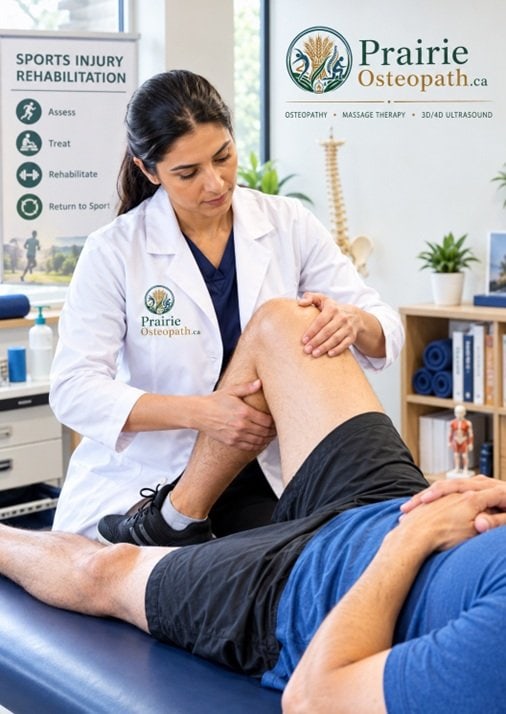
Sports Injury Rehabilitation in Regina-SK
Assessment • Recovery • Strength • Mobility • Return to Sport
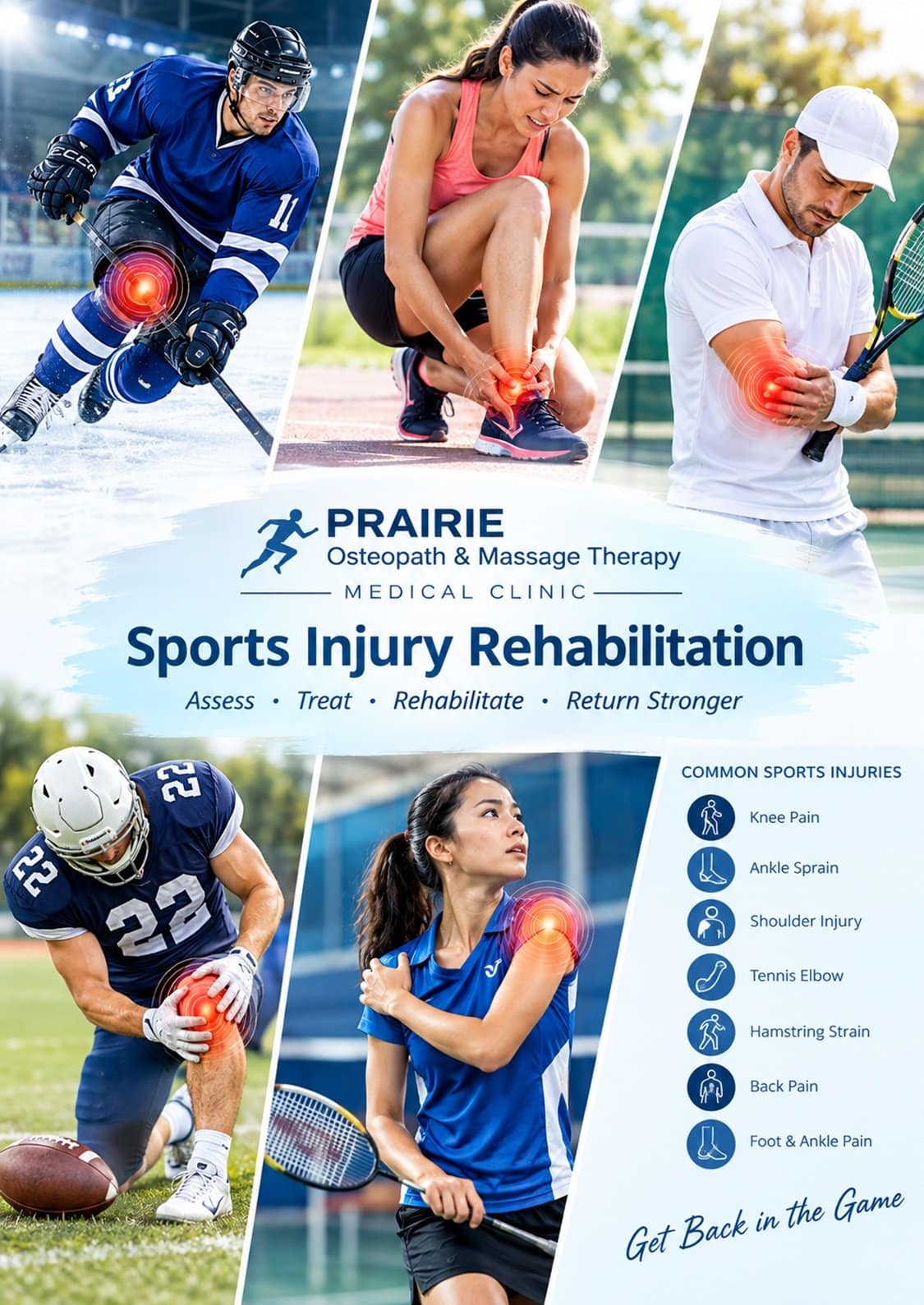
Sports Injury Rehabilitation in Regina, SK
Whether you are a competitive athlete, weekend warrior, recreational player, gym-goer, runner, cyclist, or simply injured while being active, a sports injury can affect much more than your ability to exercise. It can interfere with work, sleep, walking, lifting, and everyday life.
Don't Just Treat the Pain — Rebuild Function
An injury may start with a sudden incident such as a fall, collision, awkward landing or twisting movement. Other injuries develop gradually from repetitive training, inadequate recovery, changes in workload, poor movement mechanics or overuse.
At Prairie Osteopath & Massage Therapy Medical Clinic, we look beyond the location of the pain and consider:
- How the injury occurred
- Your sport or activity
- Training and workload
- Previous injuries
- Posture and movement patterns
- Joint mobility
- Muscle strength and flexibility
- Balance and coordination
- Functional limitations
- Your work and daily activities
- Your individual recovery goals
Our goal is to help you progress from pain and limitation → movement → strength → function → confident return to activity.
What Sports Injuries Can We Help With?Lower-Limb Sports Injuries
- Ankle sprains
- Achilles tendon problems
- Calf strains
- Shin pain
- Knee pain
- Patellar tendon problems
- Hamstring strains
- Quadriceps strains
- Groin injuries
- Hip pain
- Iliotibial band-related pain
- Muscle strains and overuse injuries
🦶 Foot & Ankle
- Ankle sprains
- Recurrent ankle instability
- Achilles tendon pain
- Plantar fascia-related pain
- Foot and arch problems
- Sports-related foot pain
- Reduced ankle mobility
💪 Shoulder & Upper-Limb Injuries
- Rotator cuff-related pain
- Shoulder strains
- Shoulder instability
- Tennis elbow
- Golfer’s elbow
- Wrist injuries
- Forearm strains
- Repetitive-use injuries
- Muscle and tendon injuries
🏃 Overuse & Repetitive-Strain Injuries
Not every sports injury occurs during a single event.
Overuse problems may develop gradually when tissues are repeatedly exposed to training or activity demands without sufficient adaptation and recovery.
Examples include:
- Tendinopathies
- Running-related injuries
- Repetitive-strain injuries
- Shin pain
- Tennis elbow
- Achilles tendon problems
- Patellar tendon problems
- Shoulder overuse
- Muscle overload
Your Individual Rehabilitation Plan
There is no single rehabilitation program that is appropriate for every sports injury.
Your program may include several stages.
Phase 1 — Pain & Symptom Management
Depending on the injury:
- Activity modification
- Manual therapy
- Massage techniques
- Mobility work
- Appropriate therapeutic modalities
- Education
- Home-care advice
Phase 2 — Restore Movement
We work toward improving:
- Joint mobility
- Muscle flexibility
- Movement quality
- Range of motion
- Normal movement patterns
Phase 3 — Rebuild Strength
Progressive exercises may target:
- Muscle strength
- Tendon capacity
- Core stability
- Joint stability
- Balance
- Coordination
- Muscular endurance
Phase 4 — Functional Rehabilitation
The exercises become increasingly similar to the activities you need to perform.
For example:
Runner: running mechanics, calf capacity, single-leg control and progressive running.
Football player: acceleration, deceleration, cutting, balance and sport-specific movements.
Tennis player: shoulder/forearm strength, rotation, footwork and racket-specific loading.
Gym-goer: progressive resistance training and controlled return to compound exercises.
Phase 5 — Return to Sport
Returning to sport is more than simply asking whether the pain has disappeared.
We consider whether you have regained appropriate:
- Strength
- Mobility
- Control
- Balance
- Endurance
- Confidence
- Sport-specific capacity
Sport physiotherapy guidance specifically recognizes functional return to sport, work and life as an important part of rehabilitation.
Manual Therapy & Massage in Sports Rehabilitation
Manual techniques and therapeutic massage may be incorporated into rehabilitation when appropriate.
Depending on the presentation, treatment may include:
Soft-tissue techniques
Therapeutic massage
Myofascial techniques
Joint mobilization
Muscle release techniques
Stretching
Mobility techniques
These approaches can be used to help manage symptoms and facilitate movement, while progressive exercise and functional rehabilitation remain important components of rebuilding physical capacity.

Sudden Sports Injury vs. Overuse Injury
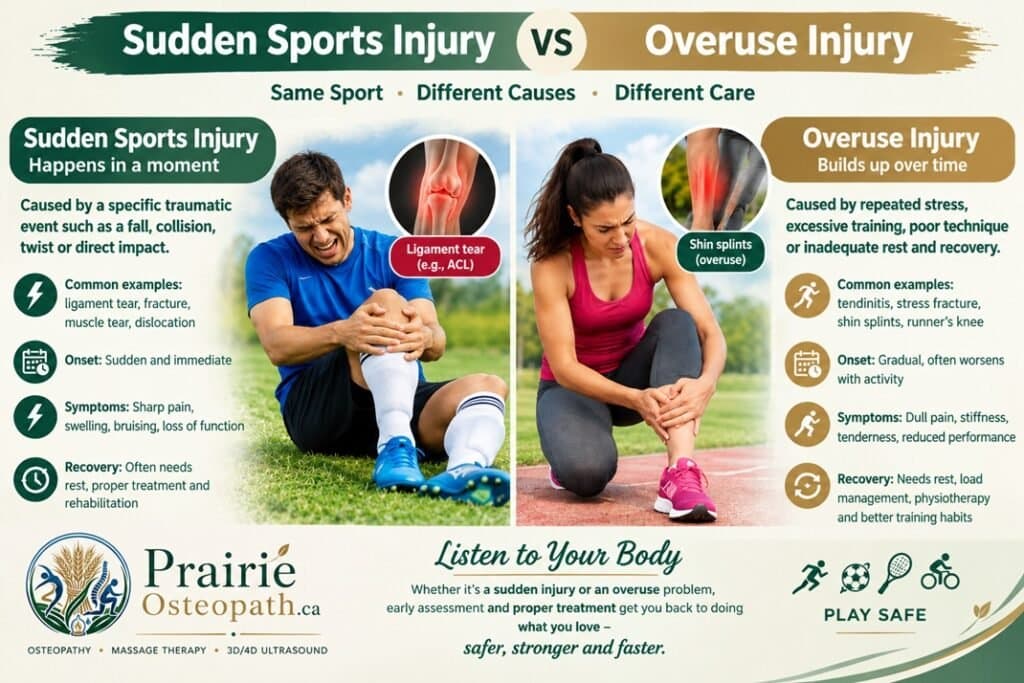
Acute Sports Injuries
These occur suddenly, often following:
- A fall
- Collision
- Awkward landing
- Sudden twisting
- Direct impact
- Sudden acceleration or deceleration
- Muscle overstretching
Examples include ankle sprains, muscle strains and some ligament injuries.
Overuse Injuries
These develop progressively and may initially feel like minor discomfort.
Repeated loading can contribute to problems involving muscles, tendons, joints and other tissues.
Warning signs may include:
- Pain that repeatedly returns during training
- Increasing stiffness
- Declining performance
- Reduced range of motion
- Pain after exercise
- Increasing recovery time
- Weakness or loss of endurance
Your Sports Injury Assessment
Don’t wait until a minor training problem becomes an injury that keeps you away from your sport.
A thorough assessment is an important first step.
Your practitioner may assess:
1. Injury History
We want to understand:
- When did the pain begin?
- Was there a specific injury?
- What movement caused it?
- Has this happened before?
- What activities make it worse?
- What helps?
- Have you already received treatment?
- What sport or activity are you trying to return to?
2. Pain & Symptom Assessment
We examine:
- Location of pain
- Pain behaviour
- Swelling
- Tenderness
- Stiffness
- Symptoms during activity
- Symptoms after activity
3. Movement Assessment
Depending on the injury, assessment may include:
- Range of motion
- Joint mobility
- Muscle flexibility
- Strength
- Balance
- Coordination
- Functional movement
- Sport-specific movement
4. Functional Assessment
Rather than asking only “Does it hurt?”, we also want to understand:
“What can you no longer do because of the injury?”
For example:
- Can you squat?
- Run?
- Jump?
- Change direction?
- Climb stairs?
- Lift?
- Throw?
- Swing?
- Kick?
- Push and pull?
- Perform your sport-specific movements?

At POMT -Regina We Don't Just Treat the Pain — Rebuild Function

Sports We Commonly See
You don’t have to be a professional athlete to benefit from sports injury rehabilitation.
Our rehabilitation approach can be relevant to people participating in:
⚽ Soccer
🏒 Hockey
🏈 Football
🏀 Basketball
🎾 Tennis
🏸 Badminton
🏐 Volleyball
🏏 Cricket
🏃 Running
🚴 Cycling
🏋️ Weight training
🥊 Martial arts and combat sports
⛳ Golf
⛷️ Winter sports
🧘 Fitness, yoga and recreational exercise
It is equally relevant if you simply injured yourself while walking, running, lifting something, working out or participating in a recreational activity.
Sudden Sports Injury vs. Overuse Injury Acute Sports Injuries These occur suddenly, often following:
- A fall
- Collision
- Awkward landing
- Sudden twisting
- Direct impact
- Sudden acceleration or deceleration
- Muscle overstretching
Examples include ankle sprains, muscle strains and some ligament injuries.
Overuse Injuries
These develop progressively and may initially feel like minor discomfort.
Repeated loading can contribute to problems involving muscles, tendons, joints and other tissues.
Warning signs may include:
- Pain that repeatedly returns during training
- Increasing stiffness
- Declining performance
- Reduced range of motion
- Pain after exercise
- Increasing recovery time
- Weakness or loss of endurance
Don’t wait until a minor training problem becomes an injury that keeps you away from your sport.
Your Assessment may include 1. Injury History
A thorough assessment is an important first step.
Your practitioner may assess:
1. Injury History
We want to understand:
- When did the pain begin?
- Was there a specific injury?
- What movement caused it?
- Has this happened before?
- What activities make it worse?
- What helps?
- Have you already received treatment?
- What sport or activity are you trying to retur
2. Pain & Symptom Assessment
We examine:
- Location of pain
- Pain behaviour
- Swelling
- Tenderness
- Stiffness
- Symptoms during activity
- Symptoms after activity
3. Movement Assessment
Depending on the injury, assessment may include:
- Range of motion
- Joint mobility
- Muscle flexibility
- Strength
- Balance
- Coordination
- Functional movement
- Sport-specific movement
4. Functional Assessment
Rather than asking only “Does it hurt?”, we also want to understand:
“What can you no longer do because of the injury?”
For example:
- Can you squat?
- Run?
- Jump?
- Change direction?
- Climb stairs?
- Lift?
- Throw?
- Swing?
- Kick?
- Push and pull?
- Perform your sport-specific movements?
Your Individual Rehabilitation Plan
There is no single rehabilitation program that is appropriate for every sports injury.
Your program may include several stages.

Phase 1 — Pain & Symptom Management
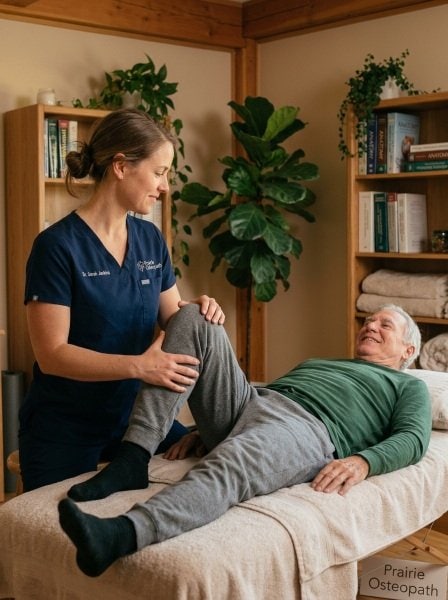
Phase 2 — Restore Movement

Phase 3 — Rebuild Strength
Manual Therapy & Massage in Sports Rehabilitation
Manual techniques and therapeutic massage may be incorporated into rehabilitation when appropriate.
Depending on the presentation, treatment may include:
- Soft-tissue techniques
- Therapeutic massage
- Myofascial techniques
- Joint mobilization
- Muscle release techniques
- Stretching
- Mobility techniques
These approaches can be used to help manage symptoms and facilitate movement, while progressive exercise and functional rehabilitation remain important components of rebuilding physical capacity.
Sports Massage vs. Sports Injury Rehabilitation
These are not necessarily the same thing.
Sports Massage
Sports massage may be useful for:
- Muscle tension
- Recovery
- General muscular soreness
- Mobility
- Preparation for activity
Sports Injury Rehabilitation
Rehabilitation goes further.
It involves:
Assessment → Treatment → Exercise → Progressive Loading → Functional Training → Return to Activity
If you have a specific injury, persistent pain or loss of function, an individualized assessment is more appropriate than simply treating the painful area with massage.
Injury Prevention & Performance
Rehabilitation shouldn’t necessarily end when your pain improves.
We can also work on reducing modifiable risk factors by addressing:
- Muscle weakness
- Mobility restrictions
- Poor movement patterns
- Balance deficits
- Training-load issues
- Poor recovery habits
- Sport-specific physical demands
- Previous injury-related limitations
A progressive exercise program can help people safely return to activity and reduce the risk of re-injury.
Most Common Sports Injuries among Recreational Athletes
You don't need to compete professionally to deserve proper rehabilitation.
🏃 Weekend Warriors
- Achilles Tendinopathy
- Patellar Tendinopathy
- Lateral Epicondylitis
- Rotator Cuff Tendinopathy
🏋️ Gym & Fitness Enthusiasts
- Rotator Cuff Tendinopathy & Subacromial Impingement:
- Afternoon snacks
- Distal Clavicular Osteolysis
- Biceps Tendinopathy
- Pectoralis Major Strains
- Acute Lumbar Strain & Erector Spinae Hypertonicity
- Lumbar Disc Herniation
🎾 Adult Recreational Athletes
- Patellofemoral Pain Syndrome
- Acute Lumbar Strain & Facet Joint Irritation
- Lumbar Disc Bulge / Sciatica
- Age-Related Tissue Elasticity Loss
When Should You See a Professional?
Consider an assessment if:
- Pain keeps returning
- Your performance has declined
- You have persistent swelling
- You have lost movement
- You notice weakness
- You cannot perform your normal sport
- You are compensating with another part of your body
- You have had repeated injuries
- You are unsure whether it is safe to return to training
For significant trauma, suspected fracture, major swelling/deformity, inability to bear weight, or concerning neurological symptoms, appropriate medical evaluation should be sought.
What About Concussion?
Head injuries and concussion require specific assessment and management protocols. Sport Physiotherapy Canada identifies concussion evaluation and management among sport-physiotherapy competencies.
What Makes Our Approach Different?
We Look at the Whole Person — Not Just the Painful Spot
A knee may hurt because of a problem elsewhere in the movement chain.
A shoulder problem may be influenced by mobility, strength, posture, technique or training demands.
An ankle injury may affect your balance and movement long after the original pain improves.
Our assessment therefore considers the injured area together with relevant joints, muscles, movement patterns and functional demands.
Our goal is not simply:
“Make the pain go away.”
The bigger goal is:
“Help you move better, become stronger and return to the activities that matter to you.”
Useful Links
Subscribe Now
Don’t miss our future updates! Get Subscribed Today!
©2022 POMT-Regina -SK. All Rights Reserved.