- +1 (306)-721-1028
- nusrathfatimaara@gmail.com
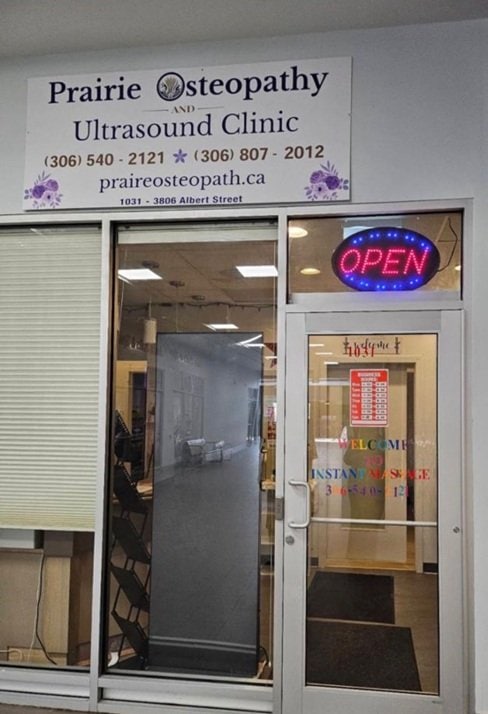
- 3806 Albert Street, Golden Mile Professional Offices Regina-SK
- 1(306)540-2121
Relieve Pain, Restore Mobility, and reclaim the life you love
Comprehensive Shoulder Pain Assessment, Manual Therapy & Rehabilitation
3806 Albert Street Golden Mile Professional Offices Regina South
From Chronic Ache to Confident Motion-Without Unnecessary Surgery!
Shoulder Pain Treatment @ POMT-Regina
Shoulder pain can make everyday activities such as reaching overhead, dressing, sleeping, lifting, working at a computer, or carrying groceries surprisingly difficult.
At Prairie Osteopath & Massage Therapy Medical Clinic in Regina, we do more than simply treat the painful area. Our approach begins with understanding why the shoulder is painful, what structures may be involved, how the shoulder is moving, and whether the problem may be coming from the neck, upper back, shoulder blade, or shoulder joint itself.
Depending on the clinical presentation, your assessment may include medical screening, posture analysis, active and passive range-of-motion testing, muscle assessment, neurological screening, orthopedic special tests, and functional movement assessment. This assessment-based approach is consistent with our clinic’s broader philosophy of Listen → Assess → Analyze → Treat → Reassess → Educate
"Stop Compansating, Start Moving"
What Causes Shoulder Pain?
The shoulder is one of the body’s most mobile regions. Its large range of movement depends on coordinated function between the glenohumeral joint, scapula, clavicle, thoracic spine, rotator cuff, tendons, ligaments, and surrounding muscles.
Because so many structures work together, shoulder pain can have several possible causes.
- Repetitive overhead activity
- Sports injuries
- Weight training
- Falls or direct trauma
- Poor posture
- Prolonged computer or desk work
- Repetitive occupational activities
- Muscle imbalance
- Reduced shoulder mobility
- Scapular movement dysfunction
- Rotator cuff overload
- Age-related degenerative changes
- Previous shoulder injury
- Cervical spine problems causing referred pain
The location and behavior of your pain can provide important clues, but pain location alone cannot determine the diagnosis.
Most Common Shoulder Conditions We Assess
1. Rotator Cuff Tendinopathy
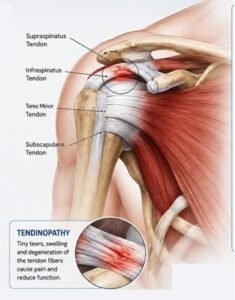
Rotator cuff tendinopathy is one of the common causes of shoulder pain, particularly in people who perform repetitive overhead activities, sports, lifting, or physically demanding work.
1. Rotator Cuff Tendinopathy
- Phone:+1 (306) 540-2121
- Email:nusrathfatimaara@gmail.com
2. Rotator Cuff Tear
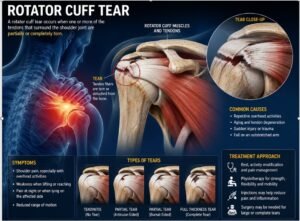
A rotator cuff tear may occur following acute trauma or develop gradually with degenerative tendon changes.
2. Rotator Cuff Tear
- Phone:+1 (306) 540-2121
- Email:nusrathfatimaara@gmail.com
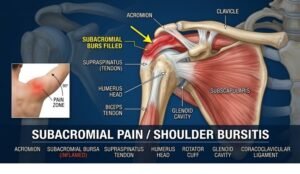
3. Subacromial Pain / Shoulder Bursitis
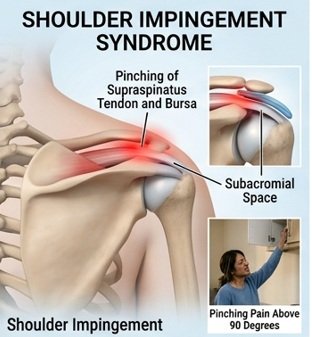
The subacromial region contains structures that can become painful with repeated loading and irritation.
3. Subacromial Pain / Shoulder Bursitis
- Phone:+1 (306) 540-2121
- Email:nusrathfatimaara@gmail.comom
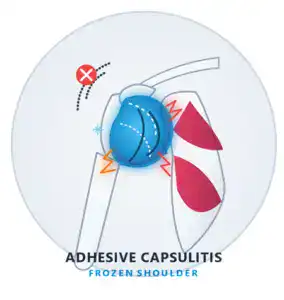
4. Frozen Shoulder / Adhesive Capsulitis
Frozen shoulder is characterized by painful restriction of shoulder movement, particularly when both active and passive movement become limited.
4. Frozen Shoulder / Adhesive Capsulitis
- Phone:+1 (306) 540-2121
- Email:nusrathfatimaara@gmail.comom
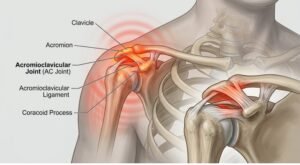
5. Acromioclavicular (AC) Joint Pain
The AC joint connects the clavicle with the acromion of the scapula.
5. Acromioclavicular (AC) Joint Pain
- Phone:+1 (306) 540-2121
- Email:nusrathfatimaara@gmail.comom
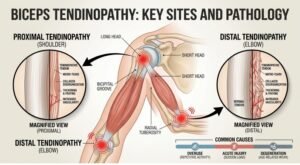
6. Biceps Tendinopathy
The long head of the biceps tendon passes through the shoulder region and can become painful with repetitive loading.
6. Biceps Tendinopathy
- Phone:+1 (306) 540-2121
- Email:nusrathfatimaara@gmail.comom
Our Unique Process Begins with Precision
Comprehensive Shoulder Assessment
1. Health History
Your assessment begins with questions about:
- Where the pain started
- How it started
- Previous injuries
- Occupation
- Sports and exercise
- Sleeping position
- Repetitive activities
- Pain intensity
- Aggravating and relieving factors
- Previous treatment
- Medical history
- Neurological symptoms
The goal is to determine whether the presentation appears appropriate for conservative care or requires medical investigation.
2. Posture Examination
A shoulder assessment may include observation of:
From the Front
- Shoulder height
- Clavicular position
- Head position
- Arm position
- Symmetry
From the Side
- Forward head posture
- Rounded shoulders
- Thoracic kyphosis
- Scapular position
- Humeral position
From the Back
- Scapular position
- Scapular winging
- Shoulder height
- Thoracic alignment
- Scapulothoracic movement
Posture is considered as one part of the clinical picture, rather than as a diagnosis by itself.
3. Active Range of Motion — AROM
Active movement assesses how the patient can move the shoulder independently.
Common movements include:
- Flexion
- Extension
- Abduction
- Adduction
- Internal rotation
- External rotation
- Functional reach behind the back
- Functional reach behind the head
We observe:
- Range of motion
- Pain
- Painful arc
- Movement quality
- Compensation
- Scapular movement
- Strength and endurance
4. Passive Range of Motion — PROM
Passive movement is performed by the practitioner while the patient relaxes.
PROM can help determine whether limitation appears more related to:
- Pain
- Joint restriction
- Muscle limitation
- Capsular restriction
- Protective guarding
A major loss of both active and passive movement can suggest a different clinical pattern than isolated weakness with relatively preserved passive motion.
5. Strength Testing
Depending on the presentation, assessment may include resisted testing of:
- Shoulder abduction
- External rotation
- Internal rotation
- Flexion
- Extension
- Scapular stabilizers
- Elbow flexion
Strength testing can help identify weakness, pain inhibition and asymmetry.
6. Shoulder Special Tests
Special tests are selected according to the patient’s history and examination findings rather than performed routinely on everyone.
Possible tests include:
Rotator Cuff / Subacromial Pain
- Hawkins-Kennedy
- Neer test
- Painful Arc
- Empty Can / Jobe test
- External Rotation Resistance
- Drop Arm test
Subscapularis
- Lift-Off test
- Belly-Press test
- Bear-Hug test
Biceps
- Speed’s test
- Yergason’s test
AC Joint
- Cross-Body Adduction test
- AC compression testing
Instability
- Apprehension test
- Relocation test
Labral Assessment
- O’Brien’s Active Compression test
- Other clinically appropriate labral tests
No individual shoulder special test should be interpreted as a diagnosis in isolation. Findings should be combined with the patient’s history, symptom pattern, ROM, strength and overall clinical examination.
Treatment
At POMT Clinic, You Get Three-Perspective Approach
Medical Doctor (MD) Perspective
- Significant trauma
- Suspected fracture or dislocation
- Severe or unexplained pain
- Significant weakness
- Suspected rotator cuff tear
- Suspected rotator cuff tear
- Neurological symptoms
- Persistent symptoms despite conservative care
- Significant swelling or deformity
- Systemic symptoms
- Concern for inflammatory or systemic disease
Registered Massage Therapist (RMT) Perspective
- Upper trapezius
- Levator scapulae
- Rhomboids
- Pectoralis major and minor
- Latissimus dorsi
- Rotator cuff muscles
- Posterior shoulder
- Cervical musculature
- Thoracic musculature
- Therapeutic massage
- Myofascial release
- Trigger-point techniques
- Deep tissue techniques when appropriate
- Neuromuscular techniques
- Therapeutic stretching
- Soft-tissue mobilization
Manual Osteopathic Perspective
- Shoulder joint
- Scapula
- Clavicle
- Thoracic Spine
- Cervical Spine
- Ribs
- Diaphragm
- Depending on the assessment, treatment may includes
- Gentle Mobilization
- Myofascial Release
- Muscle Energy Techniques (MET)
- Soft Tissue Techniques
- Fascial Techniques
- Scapular Mobility Work
- Thoracic Mobility Work
- Thoracic Mobility Techniques
- Postural Correction
- Functional Movement Restoration
Supportive Therapies
- Hydrotherapy
- Heat or cold may be used according to the presentation.
- Cold Therapy
- May be useful for short-term symptom management following an acute injury or when the shoulder is particularly irritated.
- Heat Therapy
- May be helpful for muscular stiffness and before mobility work in appropriate cases. Hydrotherapy is a complimentary services at Prairie Osteopath
Prevention is Better Than Cure!
Shoulder Pain Prevention
Preventing recurring shoulder pain requires more than occasional treatment.
1. Improve Workplace Ergonomics
If you work at a computer:
- Keep the monitor near eye level
- Avoid prolonged forward-head posture
- Keep shoulders relaxed
- Position the keyboard and mouse comfortably
- Take regular movement breaks
2. Avoid Sudden Increases in Training Load
Increase exercise volume gradually rather than suddenly increasing:
- Weight
- Repetitions
- Overhead activity
- Training frequency
3. Strengthen the Shoulder Regularly
Maintain balanced strength in:
- Rotator cuff
- Scapular stabilizers
- Upper back
- Core
4. Maintain Thoracic Mobility
Regular thoracic mobility exercises can help maintain comfortable shoulder movement.
5. Don’t Ignore Persistent Pain
Pain that repeatedly returns deserves assessment rather than repeated temporary treatment.
6. Warm Up Before Exercise
A progressive warm-up prepares the shoulder and surrounding tissues for activity.
7. Maintain Healthy Movement Habits
Avoid remaining in one position for prolonged periods. Regular movement throughout the day can help reduce accumulated muscular tension.
'A stich in time saves nine'
When Should You See a Doctor?
Shoulder pain should receive medical assessment when it is associated with:
- Major trauma
- Suspected fracture or dislocation
- Sudden significant weakness
- Inability to move the arm
- Progressive neurological symptoms
- Significant numbness or loss of sensation
- Fever or systemic illness
- Unexplained severe pain
- Persistent symptoms that are not improving
- Recurrent shoulder dislocation
- Significant deformity
A shoulder problem may sometimes be related to the neck, nerves, systemic disease or another medical condition. Appropriate referral is therefore an important part of responsible shoulder care.
Our Shoulder Pain Treatment Approach in Regina
At Prairie Osteopath & Massage Therapy Medical Clinic, we believe that the best treatment begins with the right assessment.
Your shoulder treatment may follow this pathway:
History → Posture Assessment → AROM → PROM → Strength Testing → Special Tests → Clinical Impression → Treatment → Reassessment → Home Exercise → Prevention
Depending on your individual presentation, your care may combine:
Medical assessment + Registered Massage Therapy + Manual Osteopathy + Mobility + Strengthening + Ergonomic Education + Home Exercise
Not every patient needs every treatment.
Our goal is to identify the most appropriate approach for your shoulder, your symptoms and your functional goals.
Our Location
Useful Links
Subscribe Now
Don’t miss our future updates! Get Subscribed Today!
©2019. Prairieosteopath.ca. All Rights Reserved.